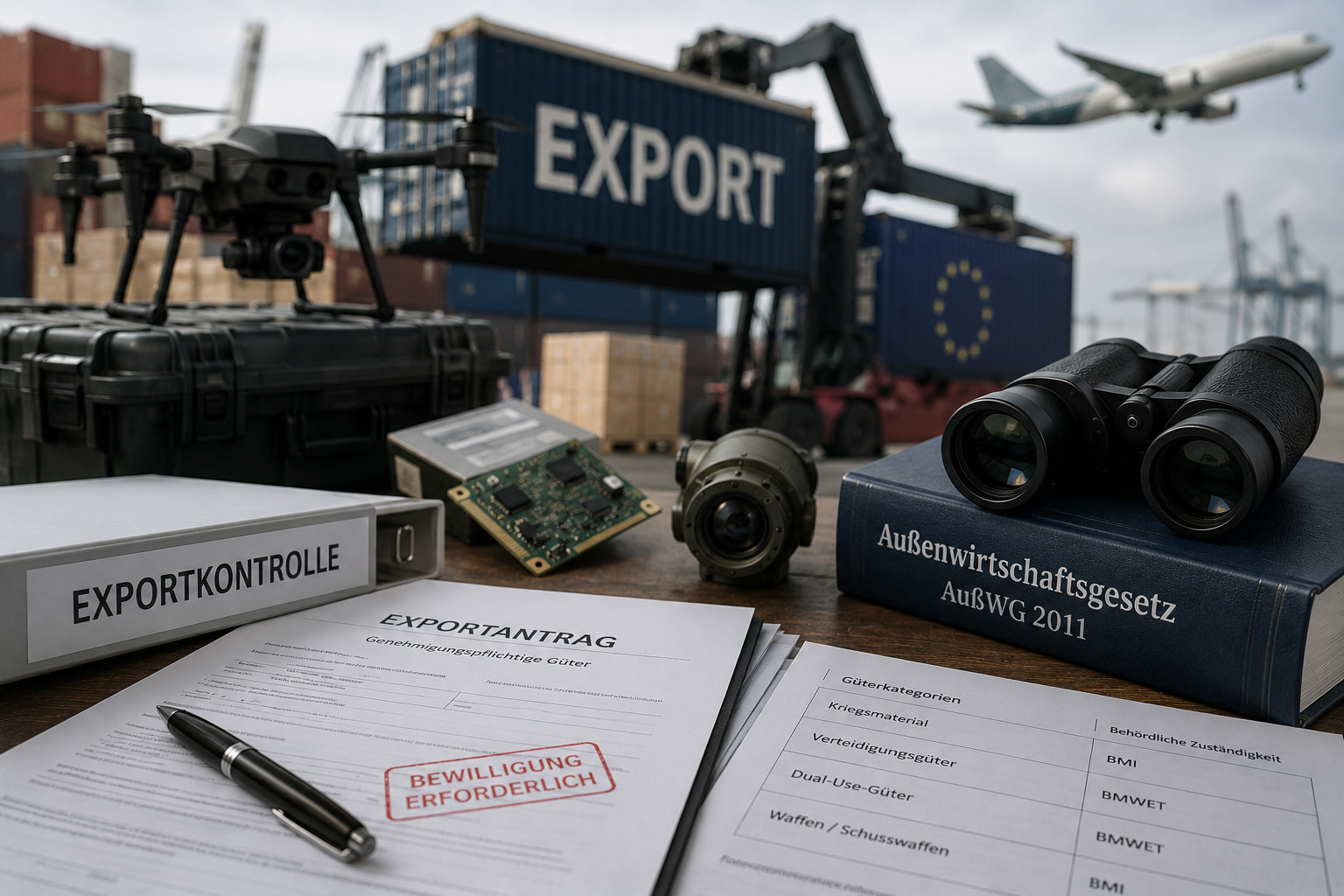
Rising investment in war materiel, defense goods, and dual-use items is opening up new production, cooperation, and export opportunities for Austrian companies. At the same time, business in this sector is subject to complex export control licensing requirements. Non-compliance can even lead to prison sentences. The regulatory restrictions under the relevant laws should not be underestimated. Incorrect classification of goods, as well as failure to obtain a license, can have significant legal and economic consequences.
Export control goes beyond traditional defense equipment
Export restrictions do not only apply to weapons and military equipment. Products, software, and technologies originally developed for civilian purposes may also be subject to export controls due to their technical characteristics or potential military application.
Items subject to export control may include, for example:
- semiconductors and power electronics,
- high-performance materials and specialty chemicals,
- radar, lidar, and thermal imaging technology,
- sensors and drone technologies,
- cybersecurity and communication solutions,
- artificial intelligence and navigation software,
- technical documentation, source code, and development data.
Export control covers more than just the physical export of goods. Simply providing software via cloud access, transmitting technical data, or sharing know-how during a video conference can be relevant under export law.
Official licenses and responsibilities
The specific legal requirements for an export depend primarily on whether the item is classified as
is to be classified.
The following overview provides a general summary of the classification of export goods and the resulting regulatory authority responsible for granting authorization
| Goods Category |
Examples |
Licensing Requirement |
War Material (KMG)
A detailed list is contained in the Austrian War Material Ordinance.
|
Examples
“classic” weapons,
missile component parts, seeker heads, flight control systems,
rocket engines and mobile launch systems,
military radars, electro-optical targeting systems, thermal imaging target sensors, fire-control computers, electronic intelligence systems,
Counter-UAS systems / drone defence systems, armed combat drones or interceptor drones
Not covered by this goods category: software without hardware; technology without hardware
|
Competent authority: BMI
Licence required
|
Defence Goods
(AußWG 2011)
A detailed list is contained in the “Common Military List” under categories ML 1 to ML 22.
|
Examples:
“classic” weapons and ammunition;
target acquisition and tracking systems, sensor fusion, mobile radars;
Counter-UAS detection, Counter-UAS interceptor systems, UAV platforms, autonomous navigation, Counter-UAS interceptor systems, unmanned maritime systems;
military decontamination equipment;
underwater sensors, mine countermeasures;
jam-resistant communications, electronic warfare, GNSS jamming and spoofing, tactical data links, SIGINT and space-based reconnaissance;
thermal imaging sensors, multispectral reconnaissance and electro-optical systems for drones and Counter-UAS;
Military software
(e.g. mission planning software; electronic warfare software; software for military drone control and swarm coordination)
Military technology
(design documentation; manufacturing parameters; source codes and technical development data; integration knowledge; testing and maintenance knowledge; technical know-how for the development, manufacture or use of military goods).
Note: The goods referred to above must each meet the performance characteristics specified in the Common Military List.
|
Competent authority: BMWET
For transfers within the EU:
Application for a licence required; authorisation is deemed granted if no prohibition is issued within 3 or 5 weeks.
For exports to third countries:
Licence required
|
Dual-Use Goods (Regulation [EU] 2021/821)
A detailed list of the goods is contained in Annex I and Annex IV of the Dual-Use Regulation (Categories 1 to 10).
Caution: In individual cases, due to a catch-all provision (exception1), goods not listed in Annex I may also be subject to a licensing requirement.
|
Examples:
cybersecurity, satellite-based communications;
radar, lidar, thermal imaging, drone sensors, laser communications and space-based Earth observation;
carbon fibres, high-performance materials, specialty chemicals;
semiconductors, power electronics, high-frequency electronics and semiconductor manufacturing equipment;
transfer of software and technology and technical know-how;
Military software and AI
(e.g. for mission planning; target recognition; autonomous navigation)
Military technology and technical know-how
(specific information necessary for the development, manufacture or use of a good / software listed in Annex I)
Note: The goods referred to above must each meet the performance characteristics specified in Annex I or IV.
|
Competent authority: BMWET
Licence required
|
Firearms
A detailed list is contained in Annex I of the Firearms Regulation.
|
Examples:
handguns; hunting and sporting rifles; sporting weapons and their components and ammunition;
Not covered by this goods category: software without hardware; technology without hardware
|
Competent authority: BMWET
For exports to third countries: Licence required
Transfers within the EU are governed by the Austrian Weapons Act (WaffG) and by the Foreign Trade Act 2011 (AußWG 2011) or the War Material Act (KMG), where the goods qualify as war material.
|
Firearms
defined in Section 1 WaffG
|
Examples:
handguns, repeating shotguns and semi-automatic firearms
Not covered by this goods category: software without hardware; technology without hardware
|
Competent authority: District Administrative Authority / Provincial Police Directorate
For (permanent) transfers within the EU:
an authorisation certificate or transfer permit is required
and, where applicable, an additional licensing requirement under the Foreign Trade Act 2011 (AußWG 2011) or the War Material Act (KMG) may apply where the goods qualify as war material.
|
Legal consequences of missing export licenses
Criminal consequences:
If war material, defense-related goods, or dual-use goods are exported without the required authorization, penalties under Section 7 of the War Material Act (KMG) or Section 79 of the Foreign Trade Act (AußWG) 2011 include imprisonment of up to three years; the sentencing range can increase to up to five years for aggravated offenses (commercial commission, deception using forged documents), and even negligent violations are punishable by imprisonment of up to one year (up to two years for war material). The same applies in the event that firearms exported to a third country in violation of the Firearms Regulation without the required permits; however, the transfer of firearms within the EU without the appropriate permit constitutes "only" an administrative offense, which is punishable by a fine (up to 3,600 euros).
The export of war material without the required permit (§ 7 KMG) can, moreover, constitute a terrorist offense within the meaning of § 278c of the Criminal Code ;2 which leads to an increase in the maximum penalty for the aforementioned offenses by half. The export of war material can also fulfill the elements of the criminal offense of § 320 of the Criminal Code "Prohibited support for parties to armed conflicts" ,3 which is punishable by a prison sentence of six months to five years.
Civil law consequences:
If defense goods, dual-use goods, or war material are exported without the required authorization, this also has implications for the civil law transaction between the exporter and the recipient.
- The Foreign Trade Act 2011 (AußWG 2011) explicitly regulates the civil law consequences of the export of defense goods and dual-use goods without the appropriate permit:
- If the export is subject to a licensing requirement, the transaction is deemed to be subject to the condition precedent of the granting of the authorization concluded, meaning it is provisionally ineffective—pending the granting or refusal of the authorization—and subsequently becomes either effective or definitively ineffective.
- However, if the export is subject to a statutory prohibition (such as an arms embargo), this immediately leads to the civil law nullity of the export transaction.
- The War Material Act (KMG) does not contain a comparable express civil law provision for legal transactions involving the export of war material. Their validity is therefore governed by general civil law provisions, in particular Section 879 (1) of the Austrian Civil Code (ABGB). Nullity of the legal transaction is particularly relevant if the parties commit to an export without the required authorization or if the agreement is aimed at circumventing the statutory authorization requirement.
We would be happy to advise and support you in planning and executing your export project through the maze of export control regulations.
Footnotes
1 Goods not listed in Annex I may also be subject to authorization if the exporter knows that the goods are intended for, or may be used for, a critical purpose (weapons of mass destruction, military end-use in a country subject to an arms embargo, digital surveillance for internal repression/human rights violations).
2 Specifically, if the act is capable of causing serious or prolonged disruption to public life or severe damage to the economy, and is committed with the intent to seriously intimidate the population, to compel public authorities or an international organization to perform, tolerate, or refrain from an act, or to seriously destabilize or destroy the fundamental political, constitutional, economic, or social structures of a state or an international organization.
3 Specifically, in the case of the export and transit of munitions in violation of existing regulations during a war or armed conflict in which Austria is not involved, or in the event of an imminent threat thereof.