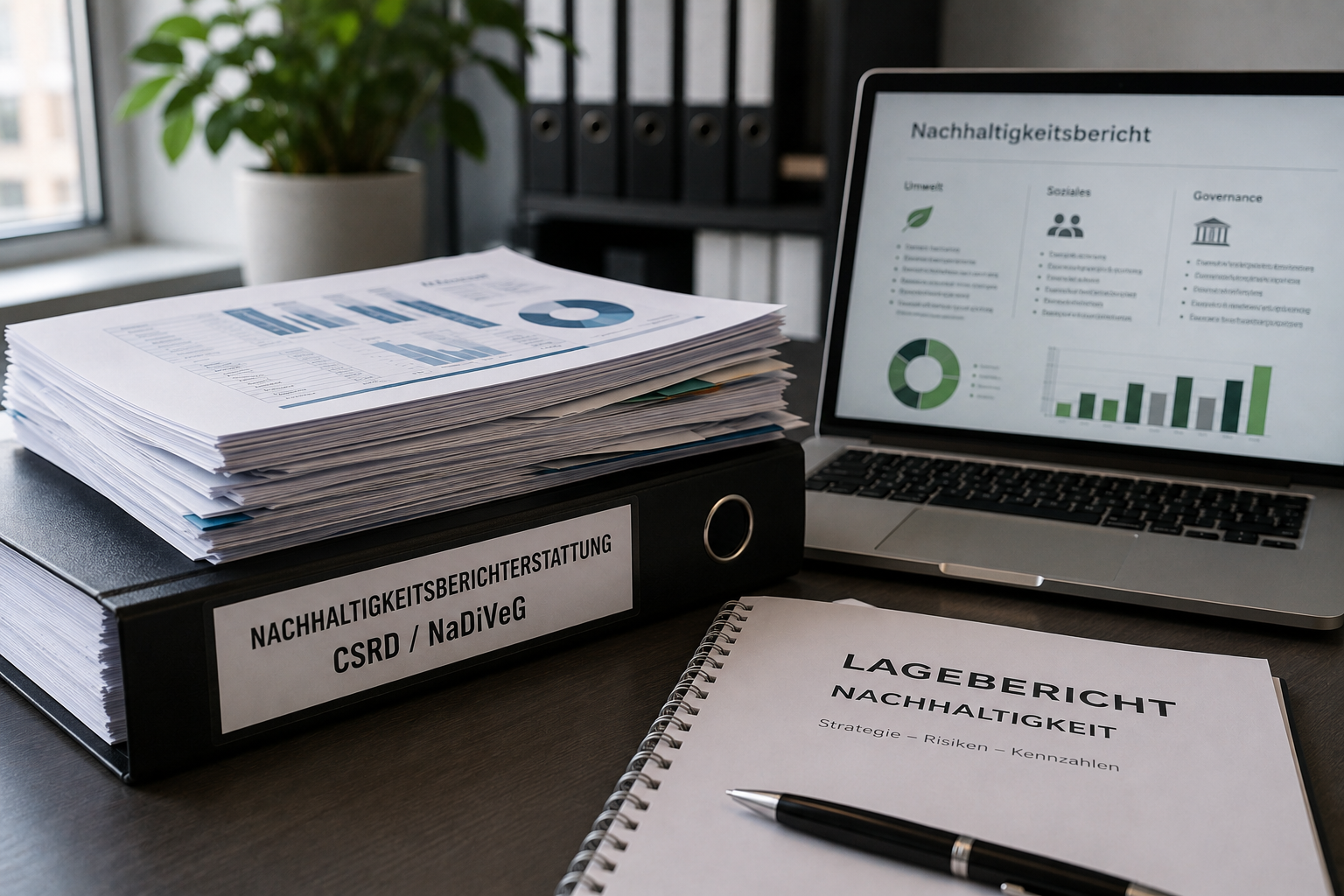
The legislator has now enacted the Sustainability Reporting Act as national implementing provisions for the implementation of EU Directive (EU) 2022/24641 on sustainability reporting, retroactively effective from January 1, 20262. In accordance with the recommendation of the European Commission ("Omnibus I Package"), the reporting obligation within the value chain was initially – starting with the financial year 2026 – limited to "Public Interest Entities" (PIE)3 with more than 1,000 employees.
The obligation for sustainability reporting comes into force in stages (Overview)!
Specifically:
Before I literally reproduce the extremely sprawling and complex provisions on sustainability reporting, let me just say this much: Many large companies have already hired entire departments of new employees to be able to comply with sustainability reporting. And many an international competitor from America or Asia will rub their hands with glee when European large companies have to provide – even if only a brief – description of their business model and strategy, including information on the resilience of the business model and strategy to sustainability-related risks; the approach taken, including implementation measures and associated financial and investment plans, to ensure their business model and strategy align with the transition to a sustainable economy and the 1.5°C global warming limit of the United Nations Paris Agreement on Climate Change; and how the company addresses stakeholder interests and the impacts of its activities on sustainability aspects within its business model and strategy.
This creates a new field of activity for auditors, which is why, for example, the Auditors and Tax Advisors Act 2017, as well as the Auditor Oversight Act, were amended.
The core of the Sustainability Reporting Act is – as mentioned – Section 243b UGB. It states:
„Sustainability Reporting
Section 243b. (1) Large undertakings as defined in Section 221 (3) first sentence, which are public-interest entities and meet the criterion at the balance sheet date of employing, on average over the year (Section 221 (6)), more than 500 employees, must include information on sustainability aspects reporting (sustainability reporting) in their management report, clearly identifiable in a dedicated section (non-financial statement).
(2) The sustainability report must contain the information necessary for an understanding of the undertaking's impact on sustainability matters, and for an understanding of how sustainability matters affect the undertaking's business development, performance, and position. Furthermore, the process for identifying the information included in the management report must be described.
(3) The sustainability report shall comprise:
1. a brief description of the company's business model and strategy, including information
a. on the resilience of the business model and strategy to risks related to sustainability matters;
b. on the opportunities related to sustainability matters;
c. on how, including implementation measures and associated financial and investment plans, the company intends to ensure that its business model and strategy are compatible with the transition to a sustainable economy and the limiting of global warming to 1.5 °C in line with the Paris Agreement adopted on 12 December 2015 under the United Nations Framework Convention on Climate Change (hereinafter: the Paris Agreement) and the objective of achieving climate neutrality by 2050 enshrined in Regulation (EU) 2021/1119 establishing the framework for achieving climate neutrality and amending Regulations (EC) No 401/2009 and (EU) 2018/1999, OJ L 243, 9.7.2021, p. 1, and, where applicable, the company's exposure to activities related to coal, oil, and gas;
d. on how the company takes into account the interests of its stakeholders and the impact of its activities on sustainability matters in its business model and strategy;
e. on how the strategy is implemented with regard to sustainability matters;
2. a description of the time-bound sustainability targets that the company has set, including, where appropriate, absolute targets for greenhouse gas emission reduction for at least 2030 and 2050, a description of the progress the company has made towards achieving those targets, and an explanation of whether the company's environmental targets are based on conclusive scientific evidence;
3. a description of the role of the administrative, management and supervisory bodies in relation to sustainability matters, as well as their expertise and skills to fulfil that role or their access to such expertise and skills;
4. a description of the company's policies with respect to sustainability matters;
5. information on the existence of incentive schemes linked to sustainability matters offered to members of the administrative, management and supervisory bodies;
6. a description
a. of the due diligence process conducted by the company concerning sustainability matters;
b. of the most significant actual or potential negative impacts associated with the company's own operations and its value chain, including its products and services, business relationships, and supply chain, and of the measures taken to identify and monitor these impacts;
c. of any measures taken by the company to prevent, mitigate, remediate, or cease actual or potential negative impacts, and of the effectiveness of these measures;
7. a description of the principal risks to which the company is exposed in connection with sustainability matters, including a description of the main dependencies in this area, and how the company manages these risks;
8. Indicators relevant to the disclosures referred to under points 1 to 7.
The disclosures referred to in this paragraph shall, where appropriate, include information on short-, medium-, and long-term time horizons.
(4) The information referred to in paragraphs 2 and 3 shall, where appropriate, include disclosures concerning the company's own operations and – in accordance with Section 243ba – its value chain, including disclosures on its products and services, business relationships, and supply chain. The information shall also, where appropriate, include references to other disclosures included in the management report pursuant to Section 243 and to the amounts reported in the annual financial statements, including additional explanations thereof.
(5) In exceptional cases, information on future developments or matters under negotiation may be omitted, provided that
1. such disclosure is, in the reasonable business judgment of the company, likely to cause serious prejudice to the company's commercial position, and
2. such non-inclusion does not prevent a true and fair understanding of the company's business performance, operating results, financial position, and the impact of its activities.
(6) The company shall report the information referred to in paragraphs 2 to 4 in accordance with the delegated acts adopted by the European Commission in line with Article 29b of the Accounting Directive (sustainability reporting standards).
(7) A company is exempt from the sustainability reporting obligation if it and its material subsidiaries are included
1. in the consolidated management report of a parent undertaking which is governed by the law of a Member State of the European Union or a Contracting Party to the Agreement on the European Economic Area, and which was prepared in accordance with the requirements of Articles 29 and 29a of the Accounting Directive, or
2. in the consolidated sustainability reporting of a parent undertaking established in a third country, which was prepared in accordance with the sustainability reporting standards adopted pursuant to Article 29b of the Accounting Directive or in a manner equivalent to these standards. The equivalence must be established in an implementing act adopted pursuant to Article 23(4) subparagraph 3 of Directive 2004/109/EC on the harmonisation of transparency requirements in relation to information about issuers whose securities are admitted to trading on a regulated market and amending Directive 2001/34/EC, OJ No. L 390 of 31.12.2004, p. 38.
(8) The exemption under paragraph 7 shall only apply if all the following conditions are met:
1. the management report of the exempted subsidiary contains the following information:
a. the name and registered office of the parent undertaking whose consolidated management report or consolidated sustainability reporting contains the information referred to in paragraph 7, together with weblinks to these documents and to the assurance opinion pursuant to Article 34(1) subparagraph 2 point aa of the Accounting Directive or to the assurance opinion pursuant to point 2;
b. the information that the company is exempt from sustainability reporting;
2. in the case of paragraph 7 point 2, an auditor authorised under the applicable law has issued an assurance opinion on the consolidated sustainability reporting;
3. in the case of paragraph 7 item 2, the consolidated sustainability reporting, together with the audit opinion according to item 2, shall be disclosed without undue delay in accordance with § 280 paragraph 2;
4. in the case of paragraph 7 item 2, the disclosures specified in Article 8 of Regulation (EU) 2020/852 on the establishment of a framework to facilitate sustainable investment, and amending Regulation (EU) 2019/2088, OJ No. L 198 of 22.06.2020, p. 13 (hereinafter: Taxonomy Regulation), concerning the activities of the exempted subsidiary and its subsidiaries, shall be included either in the management report of the exempted subsidiary or in the consolidated sustainability reporting of the parent undertaking.
(9) The exemption under paragraph 7 may not be claimed by capital market-oriented companies (§ 189a item 1 lit. a) that are large within the meaning of § 221 paragraph 3 first sentence.
(10) Companies that are obliged to provide sustainability reporting shall prepare their management report in the single electronic reporting format specified in Article 3 of Commission Delegated Regulation (EU) 2019/815 supplementing Directive 2004/109/EC of the European Parliament and of the Council with regard to regulatory technical standards for the specification of a single electronic reporting format, OJ No. L 143 of 29.05.2019, p. 1, and mark up their sustainability reporting, including the information pursuant to Article 8 of the Taxonomy Regulation, in accordance with the electronic reporting format specified in that Delegated Regulation.“
„Limitation of the reporting obligation regarding the value chain
§ 243ba. (1) When establishing contractual and other agreements for the reporting of sustainability information, an undertaking ("requesting undertaking") may not require an undertaking in its value chain which, on the balance sheet date, meets the criterion of employing no more than 1,000 employees on average per year (§ 221 paragraph 6) ("requested undertaking"), to provide information that goes beyond the information regulated in Annex I of Commission Recommendation (EU) 2025/1710 for a standard for voluntary sustainability reporting for small and medium-sized enterprises, OJ L No. 2025/1710 of 5.8.2025.
(2) Contractual provisions that contradict paragraph 1 shall be non-binding. The binding effect of the remainder of the contract remains unaffected.
(3) A requesting undertaking that requests information for the purpose of sustainability reporting that does not fall under Annex I of the Recommendation mentioned in paragraph 1 must inform requested undertakings within the meaning of paragraph 1 what information this is and that they have the right to refuse to provide this information.
(4) Any requested undertaking within the meaning of paragraph 1 has the right to refuse to provide information that goes beyond that specified in Annex I of the recommendation referred to in paragraph 1, if such information is requested for the purposes of sustainability reporting.
(5) The preceding paragraphs do not affect requests for information for purposes other than sustainability reporting, including Union requirements for undertakings to conduct a due diligence process. The preceding paragraphs neither impose an obligation on undertakings in the value chain to provide information falling under Annex I of the recommendation referred to in paragraph 1, nor do they imply such an obligation.
(6) Undertakings that provide value chain information without including information from requested undertakings within the meaning of paragraph 1 thereby comply with their obligation under Section 243b (4).“
Section 267a UGB contains an equally detailed provision on the consolidated sustainability reporting.
In the area of cooperatives, only credit cooperatives are subject to sustainability reporting (Section 243b UGB), provided that they exceed at least two of the three size criteria applicable to medium-sized capital companies and employ more than 500 employees on an annual average (Section 22 (4) GenG nF).
On par with the mandatory financial statement audit, the legislator now also legally mandates the audit of sustainability reporting (§§ 268, 269, and 269a UGB).
The auditor for the annual financial statements and, if applicable, the auditor for sustainability reporting are selected by the shareholders/stockholders; in a group, by the shareholders of the parent company. If a supervisory board exists, it must submit a nomination (for more details, see § 270 UGB nF).
The amendment to sustainability reporting has brought about changes to the Commercial Code (UGB), as well as amendments to the Stock Corporation Act (AktG), the Limited Liability Company Act (GmbHG), the Cooperative Societies Act, the SE Act, the SCE Act, the Labour Relations Act (ArbVG), the Auditors and Tax Advisors Act 2017, and many other laws.
With the new regulation of sustainability reporting, the Stock Corporation Act saw the duties of the audit committee redefined and expanded (§ 92 para 4a no 4 AktG nF); the same applies to GmbH law (§ 30g para 4a no 4 GmbHG).
Also introduced was a Third-Country Undertakings Reporting Act – DriBeG.
1 Official Journal No. L 322 of 16.12.2022, p. 15.
2 Published in the Federal Law Gazette, BGBl I 2026/6, on 18.2.2026.
3 Definition according to § 189a Z1 UGB.
4 Large corporations within the meaning of § 221 para 3 UGB.
5 Definition according to § 189a Z 1 UGB.
6 Instead of the previous key figures: Revenue € 50 million, total assets € 25 million, 250 employees.